Translation Accuracy
Translation accuracy is critical to the success of every project no matter the size. Our standard translation process includes translation plus post-translation editing/proofing by a second translator to ensure the highest quality (see translation process description below).
Affinity Translation Standard English-Arabic Translation Process
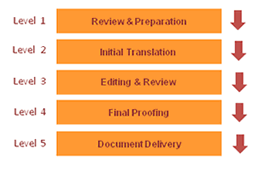
Affinity Translation translators rank among the most skilled and experienced native speaking linguists in the translation and localization industries. Despite some advancements in automated translation technologies, native speaking human translators remain the best approach for producing high quality translations.
Translation Pricing
Translation pricing is based on a per word rate determined by factoring in multiple project specific criteria including: 1) the nature (relative complexity) of the source material, 2) the scope of the project (measured in word-count), and 3) turnaround time (i.e., rush vs. standard turnaround time).
Translation Process Schedule/Turnaround Time
We recognize that translation project schedules can be critical considerations. Actual project durations vary depending on the scope and complexity of each project. We work closely with our clients to determine project schedules that allow sufficient time for high quality translation processes and project delivery in a timely manner.
Areas of Specialization
Most professional translators have areas of specialization according to their backgrounds, education, personal interests, etc. Our pledge is to assign translators, editors and reviewers that specialize in and are qualified to support the specific requirements of a given translation project. Assuring the optimal match between translator(s) and projects not only ensures high quality translations but also promotes efficiency, thereby keeping costs as low as possible. Affinity Translation has translation specialists available to support projects across a broad spectrum of subject areas and topics.
Request a Quote
Affinity Translation staff members are available to discuss your translation project and provide an approximate per word rate by telephone. To obtain a written fixed price quote for translation projects we request that clients email their document(s) for review. Please email document files to quote@affinitytranslation.com to obtain a firm fixed-price quote and estimate on turnaround time.
Contact Us for Additional Information
For additional information please contact us by email at info@affinitytranslation.com or telephone us during regular business hours at (303) 404-8699. We look forward to hearing from you.
____________
About Translation
Translation can be thought of as the interpreting of the meaning of text and the subsequent production of equivalent text, commonly known as a "translation," that communicates the same message in another language. The text to be translated is typically referred to as the source text, and the language that it is translated into is called the target language.
Translation must take into account constraints that include context, the rules of grammar of the language pairs, their writing conventions, and their idioms. A common misconception is that there exists a simple word-for-word correspondence between any two languages, and that translation is a straightforward mechanical process resulting in a word-for-word translation. In practice, however, the translation process as practiced by Affinity Translation professional translators is a blend of art and science performed by highly skilled linguists.
While attempts have been made to computerize or otherwise automate the translation of natural-language texts (machine translation) or to use computers as an aid to translation (computer-assisted translation), the highest quality translations still require the attention of people. All translation projects conducted by Affinity Translation are performed by skilled human translators that are native speaking in the target language.
If it’s important for you to connect and communicate with a foreign language audience … we can help. The language and business professionals of Affinity Translation are carefully selected for each project we perform. The skills and strengths of each specialist translator precisely match each project we perform.
|

 Home
Home


 "I will definitely be sending more work your way."